We Are Likely in the Early Stages of Another Productivity Boom
We are likely in the early stages of another productivity boom.
You can feel it before you can fully measure it. Not in the official statistics yet, not neatly captured in GDP releases or quarterly productivity reports, but in the way work itself is beginning to change. Tasks that used to take hours now collapse into minutes. Layers of friction around research, drafting, analysis, coordination, and execution are starting to thin out. The shift is still uneven, still messy, but it is becoming difficult to ignore.
Historically, productivity booms do not arrive in a clean or obvious way. The early phases of industrialization did not instantly show up as explosive gains. Electrification took time before factories reorganized around it. Even the internet, which later reshaped almost every sector, passed through a long period where its economic effects seemed strangely muted in the aggregate numbers. The real transformation tends to come not from the invention itself, but from the slower reconfiguration that follows.
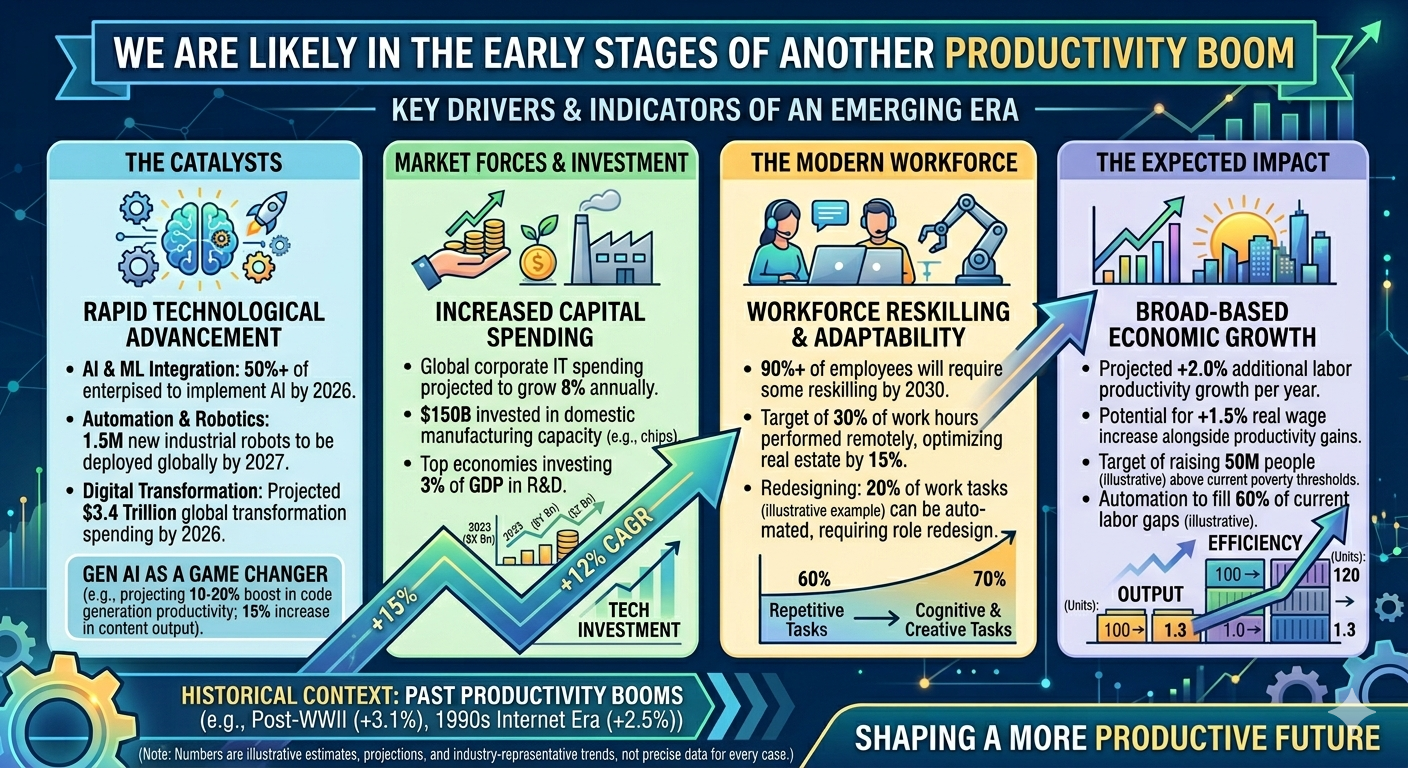
That reconfiguration phase appears to be underway now. AI systems are no longer just passive tools. In many workflows, they are becoming active collaborators. They are not flawless, and they are not replacing human judgment in any broad strategic sense, but they are increasingly effective at compressing cognitive labor. Writing, coding, summarization, design iteration, support operations, and document-heavy workflows are beginning to function differently. The old sequence of blank page, rough draft, revision, and final execution is being replaced by faster loops between intent and machine-assisted output.
At the company level, the pattern is already visible. Small teams can now produce work at a scale that previously required much larger organizations. In many cases, the bottleneck is moving away from raw labor and toward judgment. The hard part is less about whether something can be done and more about what should be done, what deserves attention, and what creates real value. That is often what a productivity shift looks like in its early stages. The gains do not simply come from doing more. They come from freeing people to spend more time on higher-level decisions.
A deeper change is also underway in how knowledge is used. Search is gradually being supplemented, and in some cases replaced, by synthesis. Instead of merely retrieving information and leaving the assembly work to the user, new systems are increasingly able to structure, summarize, compare, draft, and propose. That matters because the time savings are not only in execution. They are also in the thinking process itself. Fewer dead ends, fewer repetitive motions, fewer cycles wasted on routine assembly.
Naturally, this stage is full of noise. Some of what is happening is hype, overbranding, or premature optimism. Companies are racing to attach AI language to ordinary software. Expectations about full automation are often exaggerated. Weak outputs are still common. But that kind of speculative excess has accompanied nearly every meaningful technological shift. Underneath the noise, something more durable is taking shape. Workflows are being rewritten at a level deeper than marketing language.
One of the clearest signs is that the impact is spreading beyond the most obvious sectors. This is not just a story about software developers or venture-backed startups. Legal drafting, financial analysis, logistics planning, content production, customer support, and parts of engineering design are all beginning to experience compression. Anywhere work depends heavily on language, documentation, structured reasoning, or repeated decision-making now looks exposed to productivity gains.
The geopolitical and competitive implications may become significant as well. Productivity booms do not simply raise output. They alter the balance between firms and between countries. Organizations that adopt earlier can operate with different cost structures, faster cycle times, and greater experimentation capacity. Once that happens, others are forced to respond. The pressure becomes systemic. Adoption stops being a matter of curiosity and starts becoming a matter of survival.
The real uncertainty is not whether productivity will rise. It is how fast those gains will spread and how deeply institutions will adapt around them. Technology by itself is not enough. Firms need to reorganize. Management structures need to change. Compliance environments need to catch up. Legacy systems need to be reworked or abandoned. That adaptation can take time, and it can create the illusion that the underlying technological shift is less powerful than it really is.
Labor markets will also feel the strain. Productivity booms rarely arrive as pure good news in the short run. Some roles shrink, others expand, and new categories of work emerge in ways that are difficult to predict early on. The transition period can be disorderly. It often feels unstable even when the long-term result is greater abundance and higher output. That tension is part of the pattern, not a contradiction of it.
What makes this moment different is the speed. Earlier productivity revolutions often unfolded over decades. This one may be unfolding across years, and in some industries across quarters. That accelerates both the upside and the disruption. Businesses that adapt well may see dramatic gains. Those that move too slowly may find that the baseline expectations of speed, cost, and output have shifted around them before they fully notice what happened.
If this really is the early phase of another productivity boom, the most obvious macroeconomic signals may still be ahead. The big numbers tend to move after organizations have had time to reshape themselves around the new capability. That is when productivity statistics begin to look different, when output surprises to the upside, and when sectors that once seemed stable begin to look structurally transformed.
For now, the signs are easier to spot at ground level. A developer completes in one day what once took a week. A content team runs more experiments in a month than it used to run in a quarter. An analyst models scenarios in real time instead of spending days moving between spreadsheets, documents, and presentations. On their own, each of these looks like an incremental gain. Together, they start to compound.
That compounding effect is usually how a productivity boom begins. Not with a single dramatic moment, but with hundreds of small accelerations spreading across the economy until the broader pattern becomes impossible to miss.